NOTICE
An updated and expanded edition of this page
has been added on a new site to allow greater access to
reader participation and interaction in a message board format
the new site can be found at:
http://danizier.wordpress.com/2011/04/22/the-blasphemy-of-bibleolatry/
Please feel welcome to stop by for a visit!
Copyright (c) 1998, 2006, 2012 Davis D. Danizier / Word
Wizards communications -- all rights reserved
[E-mail address and instructions at end of this commentary]
Jump to subheading: Introduction
| Contradictions | Failed
Prophecies | Flaws/Errors
Introduction
The Bible is a tremendous, almost miraculous compendium
of wisdom and lore that has been handed down to the present world
from its ancient origins. Yet its nature and history are seldom
truly understood. It is looked at, too often, in terms of all-or-nothing
black-and-white extremes, often summarized by the question: "Is
the Bible true?"
As Pilate asked Jesus (John 18:38), "What is truth?" And, what is the truth about the Bible?
There are many who are quick to dismiss it as a fraudulent package of worthless myths, while others proclaim it to be the inerrant, infallible Word of God. But can it neatly fit into either simplistic stereotype?
Is the Bible a fraud? If someone were to come forth today and claim that they had discovered a new Biblical work, the first question would NOT be as to whether every statement in it was accurate. It would be to determine, using whatever scientific and analytical tools possible, whether the document actually came from the time and place claimed and if it was really written in the ancient times and places of the Bible. We would then try to determine its authorship and compare its contents with those of other documents whose authenticity as ancient documents has already been confirmed.
In that context, as to the legitimacy of its claims to be of serious ancient authenticity, there can be little doubt in terms of modern Bible scholarship, evaluation of documents preserved, and the historical record of those documents' origins, that the Bible is clearly the work of ancient writers. As such, it clearly gives us a window into the thoughts of ancient peoples from who much of modern ethical thinking has developed.
At the same time, the same can be said of the mythologies of the ancient Egyptians, Greeks, Romans and the civilizations of ancient India, Africa, Mesoamerica and Asia. Archeologists and anthropologists treasure the insights that verified discoveries of ancient documents provide about those ancient civilizations and how they thought and lived. Yet, though treasured and revered, few would seriously consider those writings to be the inerrant, infallible Word of God merely because they are of legitimate antiquity.
Thus the Bible, and whatever insights and wisdom can be found in it, must incontrovertibly be accepted as a great gift to the modern world. Yet that, alone, does not make it the infallible, inerrant Word of God -- a claim that would have to be evaluated separately on its merits.
It should reasonable be expected that any work that would claim authorship or inspiration from a deity described as omniscient (all-knowing) and omnipotent (all-powerful), would -- reflecting the character of its primal source -- be completely devoid of any flaws or imperfections. In fact, one of the more simplistic claims that has often been made on behalf of the Bible, is that it consists of 66 books produced over a span of some 5,000 years by more than 40 different writers and yet does not have a single contradiction or flaw in it. As we shall see, this claim is sadly far off the mark.
For all of the richness, insight, wisdom and legitimate antiquity which the Bible represents, we must remember that it came forth from a people who began their existence as nomadic refugees, first from the lands of the fertile crescent, later from Egyptian slavery, and also from subsequent conquests by Babylon (Iraq), Persia (Iran) and Rome. The books of the Bible were produced at differing times, under differing conditions, by writers who often did not know of each other and were not familiar with each other's works. In fact, in many cases we cannot truly be certain of actual authorship; we cannot verify with certitude that the names attributed to some books of the Bible were actually written by such persons. The Bible itself was not even compiled into its current form until several CENTURIES after the last event in it (other than prophecies) had occurred. The early Christians did not go to their worship services carrying their neatly-packaged Bibles -- the Bible was still be developed and, in those early times, differing communities of Christians (not to mention the Jews from whom the Old Testament of the Bible originated) had very different and sometimes conflicting compilations which only a few could actually possess in those days before inexpensive printing and production methods. Not until early in the fourth century A.D. did councils of mortal men VOTE to decide which books would be IN and which would be OUT in the final compilation of a standardized Bible. (And even today the process is not fully agreed upon, as Catholic and Protestant Bibles have differing numbers of books, and varying translations of the Bible include or exclude various contested passages.)
The result, predictably, is a book which, when carefully examined, presents us with many stunning and direct contradictions, not to mention obvious errors of fact and logic which we would expect to be unknown to ancient primitives. Additionally, just as any fortune-teller has many success stories to brag about (as well as a good number of failed predictions to try to sweep under the carpet), so the Bible, in its human frailty, also has many stunning successes in its prophecies (though some might have actually been written long after the events predicted actually occurred), but even the edited version that has come down to us also contains many glaring examples of prophecies in which events were predicted in a specific time frame or context, and that context has passed while the prophecy has NOT been fulfilled as predicted.
Let us examine each of these areas (contradictions, failed prophecies and flaws):
Jump to subheading: Introduction
| Contradictions | Failed
Prophecies | Flaws/Errors
Contradictions
1. The very first page of the Old Testament opens right up with
contradictory descriptions of the creation (Genesis 1 vs. Genesis
2). For example, if the Institute for Creation Research sought
relevant information from Genesis, would they determine that plants
were created, then animals, then humans (Genesis 1), or humans,
then plants then animals (Genesis 2)?
2. Likewise, the very first page of the New Testament introduces another major contradiction: inconsistent genealogies of Jesus in Matthew and Luke. Some have "explained" this by saying that Luke is the genealogy of Mary; such a claim acknowledges error, since Luke specifically states that it is the genealogy of JOSEPH [Luke 3:23], just like Matthew [Matt 1:16]. So, either there is a contradiction (Matthew says that Jacob is the father of Joseph; Luke says Heli is the father of Joseph, and from there back to Solomon not a single name is the same; not even the same number of generations), or one of them is making an incorrect statement about a relevant fact for Jesus' claim to the House of David.
3. In fact, the entire accounts of the birth of Jesus in Matthew and Luke are not only completely inconsistent, but also include direct contradictions.
Here are examples of details in Matthew but not in Luke:
Here are examples of details in Luke but not Matthew:
The ONLY overlapping details are the angelic annunciation and that it happened in Bethlehem, which was needed to satisfy Micah 5:2, which is often interpreted by Christians as being a prophecy of Jesus.
More significant are the direct contradictions:
4. Apostles James (brother of Jesus) and Paul (persecutor of Christians) disagreed about a key doctrine: whether "salvation" is by faith alone, or faith and works combined. Compare the direct contradictions (when analyzed for parallel vocabulary and parallel grammatical structure in the original language) in wording between Romans 3:28 and James 2:24.
Additional scriptures support faith alone (Romans 3:27-28 & 4:6; II Timothy 1:9; Ephesians 2:8-9; Galatians 2:16; Titus 3:5), while others specify the need for works / good deeds (Matt 16:27, Revelations 2:26 & 20:12; 2 Timothy 4:14; Philippians 2:12; James 2:24-26).
In a further contradictin between Paul and Jesus relevant to salvation (who will be in heaven), Jesus says that those who will enter the kingdom of God must be as little children (Matt. 18:4-5, Mark 9:36-37, 10:15, and Luke 18:17) while Paul says that maturity demands us to forsake the things of childhood (I Cor 13:11).
Thus, Jesus teaches us that the kingdom of heaven will be filled with those who lived their lives in active compassion and childlike innocence, while Paul envisions a heaven of crusty, serious "mature" grouches who merely have to profess "acceptance" of Jesus without ever actually performing a single kind, compassionate, cheerful or childishly playful deed.
In fact, it should be noted that the topic of what one must do (or be, or believe) in order to enter heaven was a consistent source of contradiction and disagreement which merits a separate discussion [click on Paul vs. Jesus or the discussion of salvation]. As noted in those separate web pages, Jesus had a very different (and conflicting) teaching from that of Paul, whose version of Christianity is essentially what has been handed down to us, owing to his phenomenal missionary success with the result that, since most of the early Christians found their way to this teaching by way of Paul, it is not surprising that it is his vision of that teaching which has survived.
4. One of the most debated issues of the Bible, which is
heatedly contested among modern Christian denominations, is whether
sin can be passed from one generation to another (some Christian
sects even teach that humans are born with inherited sins all
the way back from Adam, while others do not). These contentious
disagreements stem from the Bible's own contradictory statements
on the subject:
Deuteronomy 23:2, Isaiah 14:21-22, and Exodus 20:5 all assert
that the iniquities of the fathers are passed down through their
descendants, while Deuteronomy 24:16 and Ezekiel 18:20 state the
opposite.
Hundreds more: And that's just a few items that leap quickly to mind. A longer compilation entitled "Biblical Contradictions," with HUNDREDS of such contradictions (and still incomplete!), can be downloaded as a text file by clicking on contradictions.
Jump to subheading: Introduction
| Contradictions | Failed
Prophecies | Flaws/Errors
Failed Prophecies
1. Ezekiel chapter 26 ERRONEOUSLY predicts that during the reign
of King Nebuchadnezzar [Ez 26:7] the city of Tyre will be UTTERLY
DESTROYED, become a BARE ROCK [Ez 26:4; 26:14 - KJV says "like
the top of a rock"; NIV says "scrape away the rubble
and make a bare rock"], and NEVER BE REBUILT [Ez 26:14; 26:21].
The city was defeated in battle in 587 BC, during King Nebuchadnezzar's
reign, but was NOT "utterly" destroyed or "never
rebuilt." In fact, today has more than 20,000 inhabitants
at the core of a metropolitan area of more than 100,000 people!
The city consists of what was originally mainland and island portions;
both are mentioned in Ezekiel 26. Today the island portion is
connected to the mainland so the city appears to have coastal,
peninsula and island portions all joined. The original ruins were
not even scraped clean like "bare rock" as the ancient
ruins from all eras are preserved on both island and mainland
portions and are popular tourist destinations. So the prophecy
fails: the original city was defeated but NOT "utterly destroyed"
and scraped clean like "bare rock" within the specified
time frame, and both island and mainland portions were fully rebuilt,
bigger than ever, and even joined by the peninsula area! Even
within Bible times, long after the battle described by Ezekiel,
Tyre had already been rebuilt and, in New Testament times it is
still portrayed as a CITY (Mark 3:8) and as a harbor where ships
could unload (Acts 21:3,7) -- so I guess this could qualify not
only as a failed prophecy, but also as a CONTRADICTION.
2. Matt 12:40 clearly says: "For as Jonas was three days and three nights in the whale's belly; so shall the Son of man be three days and three nights in the heart of the earth." Please note it says THREE DAYS AND THREE NIGHTS (the same as in Jonah 1:17 which it refers to). Yet ALL FOUR GOSPELS report that Jesus died on Friday evening and was resurrected on Sunday morning (at or before dawn, some more contradictions on this point), which would only allow less than 36 hours, not three days AND three nights.
3. In Matt 24:34 Jesus reportedly predicts that the end of the world and all the fantastic "signs" he describes will occur within the lifetimes of the "current generation" or those currently living at the time Jesus spoke those words. If there is any doubt, it is clarified with far greater specificity in I Thessalonians 4:15-17, that this refers to those contemporaneously living. Yet that generation died off and the second coming and all the signs and wonders of the end times have not been fulfilled and, like all previous generations, is still being waited for by our current generation.
Simply ignoring the much more specific statements in Thessalonians, some have claimed that the reference in Matthew is to the generation in which the signs and wonders begin,. However this in absolutely nothing to suggest that the reference is to a "future" generation. Jesus is referring ot a time indicator of the future that applies to "this generation" not "that generation" of a future time. Some Bible translations, most notably "Today's English Version" developed by the conservative Reader's Digest, actually say "the generation now living" which is how their professional translators chose to conver the clear and unabiguous source text into modern English, especially in light of Thess 4:15-17.
4. Isaiah 7:14 is widely claim as a prophesy for a messiah, who shall be given the name "Immanuel." This must not be referring to the son of Mary and Joseph, since they did NOT name him Immanuel, but rather, Jesus. The only reference to the name Immanuel in the entire New Testament is Matt 1:23 referring to Isaiah's prophecy, but even Matthew never actually uses that as a name or reference to Jesus and, in fact, there is no Bible record of Jesus being named or even ever called or referred to as "Immanuel" during his lifetime.
Jump to subheading: Introduction
| Contradictions | Failed
Prophecies | Flaws/Errors
Flaws
and Errors
Numbers Chapter 31 COMMANDS the Israelites to invade the Midianites
(verse 1-2), the chapter goes on to describe the cruelty, destruction
and taking of spoils of war COMMANDED by God. It says God COMMANDS
the killing of every adult male, and this was done (verse 7).
When they return with the male children and females, they are
COMMANDED BY GOD to kill all the male children and all the females
who "have known man intimately," which is Bible language
for not being virgins (verse 17). But it tells this bunch of horny
warriors, as part of their spoils of war, to keep alive the virgin
girls "for yourselves" (verse 18) For what? To baby
sit them? Why just the girls and not the boys? Why only virgins?
Why is their sexual history relevant? Putting it into historical
context, and given what we know of the culture of that time, and
the tradition of rape and pillage allowed by conquering warriors,
and that this is given as a litany of military spoils, in that
context it clearly appears that, according to the Bible in this
passage, God (through Moses) is COMMANDING
RAPE!! (Verses 30-35 showing the command was carried out).
Some have claimed that the Midianite virgins that the soldiers
were instructed to "keep for themselves" means the soldiers
were to marry them. However, the Bible has no record of wholesale
marriage between the Israeliet soldiers and Midianites. And verses
32-35 of this chapter refer to the captured virgins as "booty"
(in the King James Version; the New International Version uses
the term "plunder"). It does not refer to them as "brides."
In any case, why would they need only brides; after all the men
lost in battle, seems they would be more in need of young men
if marriage was the object. And after the soldiers have just killed
their fathers, mothers, brothers and any sisters who weren't virgins,
I'm sure they can really look forward to loving marital bliss
(at least the Israelites won't have to worry about "in-law"
problems, but one would think a compassionate God would have more
consideration for these poor girls).
Deut 22:28-29 "[28] If a man happens to meet a virgin who is not pledged to be married and rapes her and they are discovered, [29] he shall pay the girl's father fifty shekels of silver. He must marry the girl, for he has violated her. He can never divorce her as long as he lives. (NIV)." In no way is the rape victim given a choice. The marriage MUST HAPPEN. Perhaps she had refused his proposal! All he has to do is RAPE her and she's TRAPPED for the rest of her poor, miserable life, with the person who violated her, no matter how righteous and virtuous she had tried to live. She is a double victim.
Science errors:
Aside from contemporary issues such as creationism vs. evolution, the Bible contains many other simple scientific errors:
Leviticus 11:6 asserts that hares chew the cud like cows; they do not.
Deut 14:18 classifies bats as birds; they are not birds, they are mammals
Leviticus 11:20-23 describes flying insects such as beetles and
grasshoppers and locusts as having four legs; they have six.
Not surprisingly, those promoting the Bible as the sole authority
on science tend to avoid some of these more embarrassing verses.
The Bible is pro-slavery. There are many examples in the Old Testament where slavery was approved by God; it was even COMMANDED that captives in war be taken as slaves (Num 31; Joshua 9:23). Leviticus 25:44-46 outlines the do's and dont's of permissible slavery. Verse 46 specifically permits slavery, as long as fellow Hebrews are not the slaves. In the kinder, gentler New Testament, Paul wrote that slaves should be obedient to their masters (Eph 6:5-7 & Titus 2:9-10). In IPeter 2:18, it is even specified to be submissive both to masters who are overbearing as well as gentle! Why didn't they speak out against this moral outrage? Were they afraid of the law? They could at least have remained neutral on the subject.
Leviticus gives some excellent examples of flaws and contradictions. (For those who claim that the Mosaic Law was superseded/replaced by Jesus' higher law, or that Christians are under mercy and not law, I would just say: don't go around using Leviticus to condemn homosexuals if you don't follow all of its commandments with equal enthusiasm. In any case, please note that Jesus made it clear in Matthew 5:18 that not one dot or iota would be changed or infringed until "all things are fulfilled" and "heaven and earth pass away." Are all the prophecies, including "end times" fulfilled? Have heaven and earth passed away yet? How strictly do YOU follow all the requirements in Leviticus?)
Lev chapter 11 enumerates permissible and forbidden foods. Permitted are cloven-hooved cud-chewing animals such as cows and lambs (v.3); forbidden are cloven-hooved non-cud-chewing animals (camels, etc.); additional animals prohibited as meat include rabbits (v.6), PORK (v.7). Verses 8-9 specify that fish with fins and scales are permitted, but all other seafood (specifies both seas and rivers) is an ABOMINATION. So I hope none of you Bible-lovers are too fond of shrimp, crab, lobsters, oysters, etc., are feeling too cramped by the LAW. Actually, I recommend the whole 11th chapter of Leviticus to anyone who takes the Bible too literally. Fortunately, I am a vegetarian (in the spirit of the 6th commandment) so I'm probably one of the few on this board who will make it to heaven, if these scriptures will be used as any part of the criteria for admission.
Lev chapter 12 describes a woman's uncleanliness during and after menstruation, and ritual purification for women. I hope all those women who cite Old Testament commandments against anything are strict in the obedience to these rituals. Of course, since they can't speak in Church (1Cor 14:34-35), we don't need to hear them griping about it.
The Bible would not comply with the "Defense of Marriage" Constitutional Amendment proposed by self-described protectors of "Traditional Values." The Old Testament did not define marriage as "one man and one woman" but allowed one man to have many wives as well as concubines (Genesis 29:17-28; 2 Samuel 3:2-5; 2 Samuel 5:13; 1 Kings 11:3; 2 Chronicles 11:21. It prohibited the marriage of a non-virgin woman, who was required to be executed if found out (Deuteronomy 22:13-21).
Other examples:
Exodus 35:2 clearly states that those who work on the Sabbath should be put to death. Do Bible believers feel they are morally obligated to personally kill those with jobs on Sunday (or Saturday, depending on how literally one interprets the meaning of "Sabbath" as applied in modern times)?
Lev. chapter 21, verses 17-24, makes it very clear that those with a variety of disabilities are not welcome to approach the altar of God. Will Bible believers initiate a campaign to overturn the wicked Americans with Disabilities Act? Verse 20 specifically mentions any defect or "blemish" in one's vision. I have to admit that I wear prescription glasses. Does my vision have to be 20/20, or is there some wiggle room here?
Deut. 23:1-2 Commands that a man wounded in the genitals be considered an outcast, and that a bastard (the innocent child of illicit sexual relations) be outcast "even to his tenth generation." (No wonder abortion was practiced, and permitted in the law -- and in fact, is not prohibited in any place in the Bible.)
Exodus 22:18 COMMANDS the killing of witches. Lev 20:27 (KJV) commands the killing of WIZARDS (Does that include the Wizard of Oz?)
2 Kings 2:23-24 shows that God, through his prophet Elisha, causes two she-bears to attack 42 "small boys" simply because they made fun of Elisha's baldness.
Judges 11:29-40 God's covenant with Jephthah requires Jephthah to give his virgin daughter as burnt offering, and it is done. Not only is this offering of a virgin as a human sacrifice (and his own daughter to boot!) extremely barbaric, it also directly contradicts the prohibition in Deuteronomy 18:10 against allowing one's own "son or daughter to pass through fire."
What the Bible IS and IS
NOT
But the real question is: What does the Bible itself say about
its own "infallibility"? Actually, it says nothing.
The Bible in its current compilation didn't even exist until several
centuries after the last book was written. Why are religious zealots
so quick to claim divine authorship of a book that doesn't even
claim it for itself (with the exception of specific portions of
law and prophecy such as "Thus sayeth the Lord...,"
but not to the modern Bible as a whole)? The Bible was a collection
of separate writings (laws, plays, poems, songs, histories and
letters) by individual religious commentators who never imagined
their writings would ever be considered divine. They are just
like modern writers, making commentary and analysis, who just
happened to have their works assembled and voted on by later believers
who then canonized their words. They refer to the sanctity of
sacred scripture (the body already canonized before their time
-- such as the Law of Moses and the writings of the Old Testament
prophets) never imagining that someday THEIR writings, letters,
or whatever will be added to the canon. Paul the Apostle, who
clearly believed that the established scripture of his day was
inspired (see 2Tim 3:16), also clearly acknowledged that some
of his own writings were NOT, as when he wrote in 1 Cor 7:12 "But
to the rest speak I, NOT THE LORD..." (emphasis added); and
2 Cor 11:17 "That which I speak, I speak [it] NOT AFTER THE
LORD..." (emphasis added).
It is not necessary for good Christians to accept the Bible as the infallible Word of God in order to understand and believe in Jesus' teachings of universal compassion. After all, the early Christians themselves did not have an "infallible Bible" to carry around with them -- it wasn't even compiled until centuries later. Just as we gain insights and understanding from modern writers and commentators of today, without claiming that they are divine and infallible, we can gain insight and understanding from ancient writers, as long as we consider their works for what they are, with critical thinking and common sense -- not just blind faith.
We should accept the Bible for what it is: often wise and inspirational, but many times filled with error and cruelty. It is an important historical relic, and the original seed from which much of ethical theory in the Western world has developed, but its words must be discussed, analyzed and evaluated on their merits -- as the writing of men, not of God. It does not claim to be anything more.
P.S.: Contradictions in
the Koran (Qur'an)
Several readers have written to inquire about contradictions in
the Koran (or Qur'an). I have read the Koran and own print and
computerized versions of it. The Koran does contains many contradictions
and flaws, not to mention "hate speech" (seeking death
to Christians and Jews and oppression of women). But having grown
up Christian, not Moslem, and addressing a North American readership
far more Christian than Moslem, I'll focus on the Bible. Those
interested in the Koran can check an excellent website: http://www.answering-islam.org/Quran/Contra.
Jump to subheading: Introduction | Contradictions | Failed Prophecies | Flaws/Errors
Copyright (c) 1998, 2006, 2012 Davis D. Danizier / Word Wizards communications -- all rights reserved
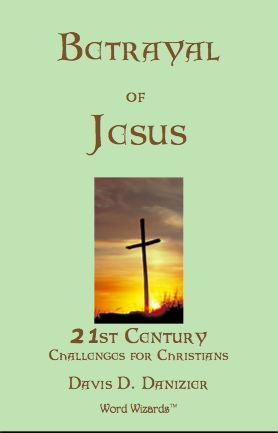
NEW Compiled Commentaries now available in Printed Book form:
The original small 55-page booklet version of the online commentaries has now been replaced by a comprehensive 184-page book with all the material in the commentaries PLUS substantial additional new material synthesized into an overarching theme, and then goes from there to introduce extensive new reference material, amazing new scriptural references you never knew were in the Bible, and entire new sections:
Bible Study like they never taught you in Sunday School!
This new, expanded print edition (also available in e-book versions for Apple iPad, Amazon Kindle, and Barnes & Noble Nook) is a valuable resource for those who prefer to read a printed edition and maintain it for reference purposes, or to have as a handy guide when traveling or discussing issues with others. It is also in a convenient format for giving to others who may be of like mind, or who might be interested in considering a different view than what they have taken for granted for many years.
|
The Book Betrayal of Jesus is now vailable in print and e-book editions: To order from Amazon.com (print edition or Kindle e-book): To order from Barnes and Noble.com (print edition or Nook e-book): To order e-book for Apple iPad: To "Like" this book on Facebook: To order directly from the Publisher by mail: $14.95 per book + one-time charge of $2.00 shipping/handling (regardless of quantity) |
|
Publisher orders are invoiced through http://www.wordwiz72.com.
References and suggested further reading:
Who Wrote the New Testament: The Making of the Christian Myth. Burton L. Mack. (1995; San Francisco: HarperCollins) 326 pages. (Burton L. Mack is professor of early Christianity at the School of Theology at Claremont and associate scholar at the Institute for Antiquity and Christianity in Claremont.)
James, the Brother of Jesus by Robert Eisenman (1997; Penguin Books) 1,074 pages. (Robert Eisenmann is Professor of Middle East Religions and Archaeology and Director of the Institute for the Study of Judeo-Christian Origins at California State University, Long Beach; Visiting Senior Member of Linacre College, Oxford University; National Endowment for the Humanities Fellow at the Albright Institute of Archaelogical Research in Jerusalem; Senior Fellow at the Oxford Centre for Postgraduate Hebrew Studeis.)
Misquoting Jesus, by Bart D. Ehrman (2005; San Francisco: HarperCollins) 242 pages. (Bart D. Ehrman is char of the Department of Religious Studies at the University of North Carolina at Chapel Hill. Ph.D. and M.Div from Princeton Theological Seminary. President of the Southeast Region of the Society of Biblical Literature.)
The Nag Hammadi Library, edited by James M. Robinson, general editor, Professor Emeritus of Religion at Claremont Graduate University and the founding director of the Insitute for Antiquity and Early Christianity in Claremont.
The Gnostic Gospels, by Elaine Pagels, Professor of Religion at Princeton University and winnder of a MacArthur Fellowship.
The Five Gospels, by the Jesus Seminar (1993, New York: Macmillan) 553 pages.
The Jesus Seminar is a scholarly committee of eminent scholars in religion and religious history.
General Editors:
Robert W. Funk, Westar Institute
Julian V. Hills, Marquette University
Editors of Apocryphal Gospels:
Ron Cameron, Wesleyan University
Karen L. King, Occidental College
Scholarly Panel of 20 additional eminent scholars headed by Roy W. Hoover, Whitman College
Updated Commentaries and Interactive Forums:
Bible web page:
With respect for the important contributions of the Bible in history, literature, and its ethical and cultural influences, this essay debunks the Christian myth of Bible inerrancy / infallibility, and demonstrates that it is a work of fallible humans, not of divine creation, citing extensive specific examples of contradictions, factual errors and failed prophecies.
http://danizier.wordpress.com/2011/04/22/the-blasphemy-of-bibleolatry/
Paul vs. Jesus web page:
This essay illustrates how the "apostle" Paul contradicts and undermines the teachings of Jesus and other early Christians (most notably James, the brother of Jesus, who fought in vain to protect the integrity of his brother's message). Paul began as a persecutor of Christians and seems to have found a more effective manner by which to undermine and oppose the teachings of Jesus. As the great missionary through whose perspective new followers of Jesus came to "Christianity," it is the vision of Paul, not Jesus' simple teaching of joyful compassion, which has survived.
http://danizier.wordpress.com/2011/04/22/paul-vs-jesus-and-james/
Atonement web page:
This essay demonstrates the logical, moral and scriptural fallacies in trying to concoct a doctrine that says that one person's sins can be removed or "atoned for" by killing another innocent human in an act of barbaric human sacrifice.
http://danizier.wordpress.com/2011/04/22/bloody-human-sacrifice-atonement-mythology/
Web page on special issues relating to Catholics and Catholicism:
This essay demonstrates the how the history of the Roman Catholic Church is replete with barbaric cruelty, incredible depths of corruption, and crimes against humanity that are not only part of its ancient history, but continue into the present day.
http://danizier.wordpress.com/2011/04/22/special-problems-for-catholics/
Web page on special issues relating to Mormons and Mormonism:
This essay demonstrates some of the theology and practices of the Church of Jesus Christ of Latter-day Saints (Mormons) that are unique and intriguing among Christian faiths. The history, beliefs, doctrines and rituals also bring some troubling dimensions that are worth exploring.
http://danizier.wordpress.com/2011/04/21/special-problems-for-mormons/
Christianity and Popular Culture:
This essay addresses some of the miscellaneous issues of how modern Christianity tries to deal with issues of popular culture, public policy, political influence and social issues.
http://danizier.wordpress.com/2011/04/21/christianity-and-culture/
Is There a God?:
This age-old question invites much speculation, and there have been many attempts to wrestle with the big issues of the cosmos throughout history -- first in the realm of religious mysticism, and later incorporating issues of science. This short piece attempts to integrate the factors that need to be considered, addresses previous historical efforts, and provides a framework of factors to consider in coming up with whatever feasible answers may be possible.
http://danizier.wordpress.com/2011/04/21/is-there-a-god/
Go to Danizier bio and introductory page: http://www.wordwiz72.com/danizier
Return to Word Wizards home page